EVA vs PVC Slippers: Which Material Is Better for Wholesale Buyers?
- EVA slippers are usually lighter, softer and more comfortable, making them suitable for home, hotel, spa, beach and casual lifestyle markets.
- PVC slippers are generally heavier and more durable, and may be suitable for budget channels, wet environments or heavy-use scenarios when the formula meets target-market safety requirements.
- Wholesale buyers should choose the material based on target market, retail price, expected comfort level, durability requirement, anti-slip performance, compliance documents and shipping cost.
Quick answer: should wholesale buyers choose EVA or PVC slippers?
For most lightweight comfort slipper programs, EVA is usually the better choice because it is soft, light and easy to mold. For budget-focused or heavy-use channels, PVC may be considered when the buyer needs higher abrasion resistance and the supplier can provide safe, compliant material formulas.
There is no single best material for every order. The better material depends on where the slippers will be sold, who will use them, how long the product should last, what price point the buyer needs and which compliance documents the target market requires.
EVA slippers: advantages and suitable use cases
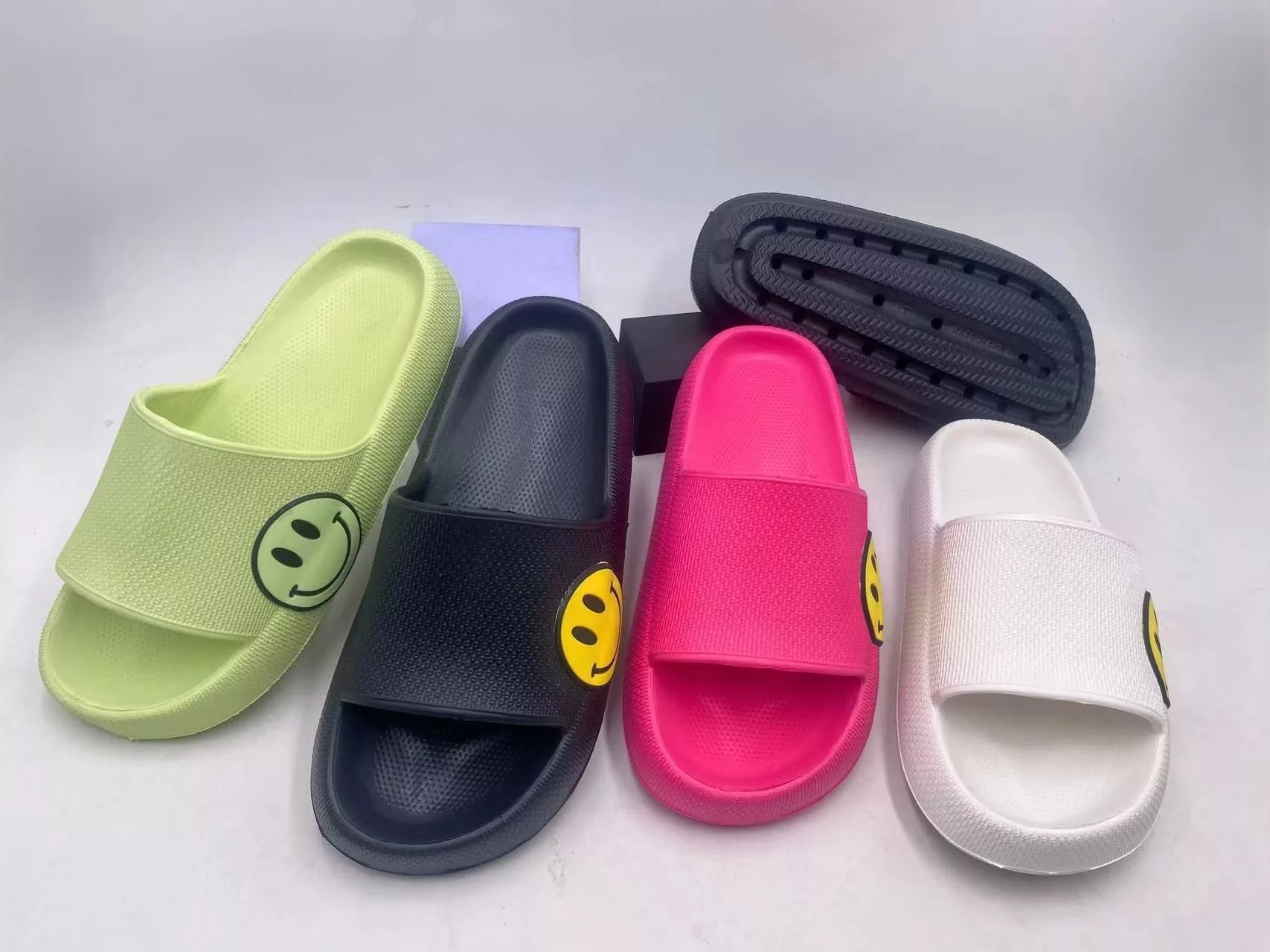
EVA slippers are popular in wholesale footwear because they are lightweight, flexible and comfortable for daily wear. The material can be produced in different hardness levels and can support many shapes, colors and outsole patterns. This makes EVA suitable for fashion slippers, bathroom slippers, hotel slippers, spa slippers, beach slippers, garden clogs and casual home footwear.
- Best for: comfort-focused retail, hotel and resort supplies, spa and wellness products, beachwear, casual lifestyle collections.
- Buyer benefit: light weight can reduce shipping pressure and improve customer wearing experience.
- Key risk to check: shrinkage, odor, size stability, outsole grip and material consistency.
PVC slippers: advantages and suitable use cases
PVC slippers can be useful when the buyer needs a more durable and cost-controlled product for wet or rough-use environments. Depending on formula and production quality, PVC can provide strong wear resistance and shape stability. However, buyers should pay close attention to chemical restrictions, phthalate limits, odor and market-specific safety requirements.
- Best for: budget retail channels, wet environments, public-use facilities, promotional supplies and markets where durability is more important than lightweight comfort.
- Buyer benefit: can offer good abrasion resistance and long use life in some heavy-use scenarios.
- Key risk to check: formula safety, restricted substances, weight, flexibility in cold weather and possible odor.
EVA vs PVC slipper comparison table
| Comparison point | EVA slippers | PVC slippers | Buyer decision tip |
|---|---|---|---|
| Weight | Usually lighter | Usually heavier | Choose EVA when freight cost and comfort are priorities. |
| Comfort | Soft, flexible and cushioning | Can be firmer depending on formula | Choose EVA for home, spa, hotel and lifestyle markets. |
| Durability | Good for daily casual use | Can be strong for heavy-use environments | Choose PVC only if formula and safety documents are confirmed. |
| Anti-slip performance | Depends on outsole design and material hardness | Depends on outsole pattern and surface condition | Always test for the actual use scenario, especially wet floors. |
| Cost structure | Competitive for lightweight molded styles | Can be cost-effective for simple durable styles | Compare total cost including freight, defect rate and return risk. |
| Compliance focus | Material traceability, odor, heavy metals, restricted substances | Phthalates, heavy metals, odor and restricted plasticizers | Ask for market-specific test reports before bulk orders. |
| Sustainability | Can support bio-based or recycled-content options if documented | Recycling and disposal may be more complex | Avoid unsupported green claims; use certificates where available. |
How to choose by target market
The following suggestions can be used as a practical decision matrix.
| Target market / channel | Recommended material direction | Reason |
|---|---|---|
| Europe and North America lifestyle retail | EVA first | Buyers usually value comfort, lightweight design, chemical compliance and brand presentation. |
| Hotel, spa and resort supply | EVA first | Soft touch, clean appearance, lightweight shipping and bathroom usability are important. |
| Budget wholesale channels | EVA or PVC depending on price point | The buyer should compare unit cost, carton volume, return risk and target safety rules. |
| Wet or rough-use environments | PVC may be considered | Durability and abrasion resistance may be more important, but formula safety must be checked. |
| Beach, pool and summer promotion | EVA first for lightweight comfort; PVC for certain low-cost programs | The decision depends on expected wearing time, price level and anti-slip requirements. |
| ESG-oriented brands | Documented EVA options | Bio-based or recycled-content claims must be supported by certificates or supplier documentation. |
Essential compliance benchmarks for entering major global economies
The following are the essential compliance benchmarks for entering major global economies:
| Core target market | Mandatory Compliance Audit Indicators for 100% Virgin EVA | Mandatory Compliance Audit Indicators for PVC Environmental Compliance | Latest International Certifications and Standards (2026) |
|---|---|---|---|
| The 27 EU member states | Zero added phthalates; controlled VOC emissions; full compliance with strict EU regulations regarding the ban on the destruction of unsold goods and Digital Product Passport (DPP) requirements. | Total content of regulated phthalates ≤ 0.1% (1000 ppm); heavy metal migration strictly complies with EU toxicological standards. | REACH Regulation (SVHC list updated to 253 substances as of 2026), ESPR 2024/1781/EU (Ecodesign for Sustainable Products Regulation), EN 71-3 |
| North America (US/Canada) | Lead-free formulation (total lead content ≤ 90 ppm); the entire line of children's products fully aligns with chemical restriction and exemption standards for consumer products regarding contact safety. | The content of six restricted phthalates is ≤ 0.1%; physical safety and flame retardancy standards comply with U.S. Consumer Product Safety Commission (CPSC) regulations. | CPSIA, ASTM F3445-21 (slip-resistant safety performance), CA Prop 65 (California Proposition 65) |
| Australia/New Zealand | Traction on wet, slippery surfaces must meet the P4 rating in the wet pendulum test (or a dry friction coefficient ≥ 0.40); packaging recycling labels must align with APCO guidelines. | High-level UV aging resistance test (no structural degradation or cracking after 100 hours of intense UV exposure). | AS/NZS 4586 (core standard for slip resistance classification), GECA (Good Environmental Choice Australia certification) |
| Middle East/Southeast Asia | Toxicological safety verification (non-toxic); IPX4-rated water and moisture resistance; thermal stability testing (deformation rate ≤ 1.5% after 72 hours of high-temperature baking at 60°C). | Meets DIN standards for abrasion resistance; passes 48-hour salt spray corrosion testing, making it suitable for hot, humid, and high-salinity climates. | SASO Certification (Saudi Arabia), SNI (Indonesia), TISI (Thailand) |
What compliance documents should buyers prepare?
Compliance requirements vary by country, product category and retailer. Before ordering, buyers should confirm the required standard with their importer, testing laboratory or retailer. The supplier should then quote and sample according to that requirement, instead of adding documents after production is finished.
- For EU-oriented orders: check chemical restrictions, restricted substances, heavy metals and retailer-specific requirements.
- For US-oriented orders: check CPSIA requirements when children’s products are involved, relevant retailer policies and California Prop 65 if applicable.
- For Australia and New Zealand: pay attention to slip resistance and labeling requirements based on the selling channel.
- For Middle East and Southeast Asia: check local labeling, heat resistance, packaging, humidity resistance and any market-specific certification requirements.
Shipping and total cost: why material weight matters
Wholesale buyers should calculate total landed cost, not only FOB price. A lighter slipper may reduce shipping pressure, increase carton loading efficiency and improve gross margin after freight, duty, warehouse handling and return costs are included. A cheaper material is not always cheaper after overseas logistics and customer complaints are considered.
When asking for a quotation, buyers should request carton size, pairs per carton, gross weight, net weight, estimated container loading quantity and packing method. These numbers allow the buyer to compare EVA and PVC slippers more accurately.
Supplier questions for EVA vs PVC selection
- Can you recommend EVA or PVC based on my target market, retail price and use scenario?
- What material hardness, weight and outsole pattern do you suggest for this use case?
- Can you provide test reports or arrange testing according to my country’s requirement?
- What is the MOQ for existing mold, new color, private label packaging or new tooling?
- What is the carton size, weight and estimated container loading quantity?
- Can we approve a pre-production sample before mass production?
Buyer FAQs
A: EVA slippers are usually better for lightweight comfort and lifestyle use, while PVC slippers may be better for certain durable or budget-focused use cases. The best choice depends on target market and compliance requirements.
A: EVA is generally softer and lighter, so it is commonly selected for comfort-focused home, hotel, spa and beach slippers.
A: PVC slippers can be exported when the formula meets the target market’s chemical and labeling requirements. Buyers should request test reports for restricted substances and phthalates when applicable.
A: EVA is usually preferred for hotel and spa slippers because it is lightweight, comfortable and easy to clean, but the final decision should consider budget and anti-slip needs.
A: Compare total landed cost, including unit price, carton size, container loading quantity, defect rate, compliance testing, freight and after-sales risk.
How Guangzhou Haochuan presents material selection expertise
For a B2B slipper manufacturer, it is essential not only to explain the suitability of various materials but also to demonstrate how factory expertise helps buyers select materials best suited to their specific markets.Guangzhou Haochuan can present material comparison charts, sample cases, outsole options, packing examples and test-document workflows to show professional sourcing support.